Delta layout basics
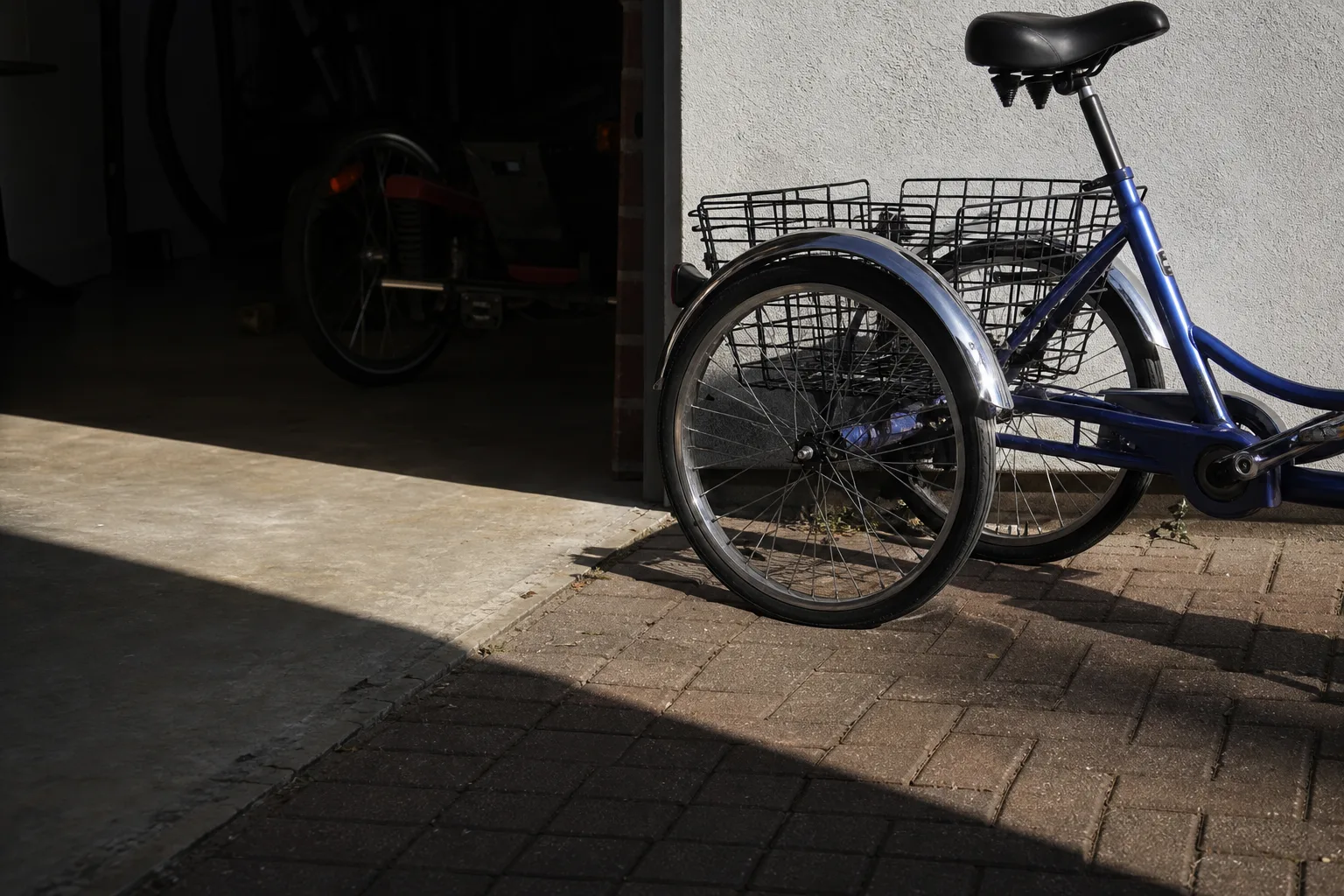
A delta trike has one steering wheel in front and two driving wheels behind, with the rider seated in a chair-like position. Eye height is usually similar to that of an upright bicycle.
One rider's write-up after trying three-wheelers at two shops, a rehab centre loan pool and a used listing that turned out to be too wide for the gate. Most of it is about what happens after the purchase.
The three layouts people usually end up choosing between are a delta trike with two wheels behind and one steering wheel in front, a tadpole trike with two steering wheels in front and one driving wheel behind, and an upright two-wheeler with a step-through frame low enough to walk over rather than swing a leg across. They ride differently, but the differences that matter most show up while stopped, not while moving. A careful shopper tests the stopped parts first, on a slope, wearing the shoes and the coat actually owned.
A delta trike puts the rider in something close to a chair, hips roughly at the height of a kitchen stool, feet reaching down and forward. A tadpole puts the hips lower, sometimes below the top of the front wheels, with the legs stretched almost horizontally ahead. A low-step upright keeps the classic bicycle posture, saddle set so the ball of one foot, or a whole flat foot on a shorter frame, reaches the pavement. Every other question in this comparison follows from that one number, so measure it against a chair that is comfortable to rise from unaided.
Mounting a delta usually means standing beside the seat, holding the frame or a grab handle, and lowering onto the pad, which is a controlled sit rather than a step across. A tadpole asks for a deeper descent and a push back up, and rising from one resembles getting out of a low sports car. A low-step bike asks for a single step over a top tube that may sit only a foot or so above the ground, then a settle onto the saddle with both feet down. Try each on a driveway with a grade, since level showroom floors flatter everything.
Eye height on a delta is close to what a rider on an upright bike is used to, which keeps the head above parked car rooflines and inside the ordinary sweep of a driver's mirror. A tadpole sits lower, and while the wide front track and bright frame colors help, a flag on a fiberglass pole is standard equipment rather than an accessory for a reason. A low-step upright gives the highest eye position of the three, useful for looking over a hedge at a blind driveway. The Consumer Product Safety Commission oversees federal requirements for bicycle reflectors and related equipment, and both trike types are usually built to meet the same expectations.
This is the scenario worth rehearsing, because it is the one that ends badly on a two-wheeler and merely ends on a trike. On a delta or tadpole, a foot off the pedal drops toward the ground while the machine keeps standing, and the risk is a heel catching pavement and being dragged backward under the seat, which is exactly why heel slings or toe cages appear on trikes with any recline. On a low-step upright, the same slip usually means putting a foot down and stopping, which works if the standover clearance allows both feet flat. Check the recovery, not just the slip.
Sit on each machine, come to a full stop on a slight incline, and get off without help, twice. Ask what the seat height is in inches and compare it with a chair at home. Look at whether the pedals have retention, and whether it can be released quickly with cold hands. Note how far the eyes are from the ground while seated and whether a flag mount is fitted. Then measure the widest point of the frame, since a tadpole's front track and a delta's rear axle set the width every gate, garage door and hallway will have to accommodate afterward.
None of these three is the safe answer and the others the compromise. The delta trades a little cornering confidence for an easy sit-down entry and a familiar eye height, the tadpole trades eye height for a low center of gravity and steady braking, and the low-step upright keeps the smallest footprint and the highest view for anyone who can still put both feet down reliably. The right one is whichever the body can leave, on a hill, without thinking about it.