Steering effort over a mile
Gentle steering geometry turns camber drift into background noise, while quick steering turns it into work. A mile on a real crowned street reveals the difference that a parking lot cannot.
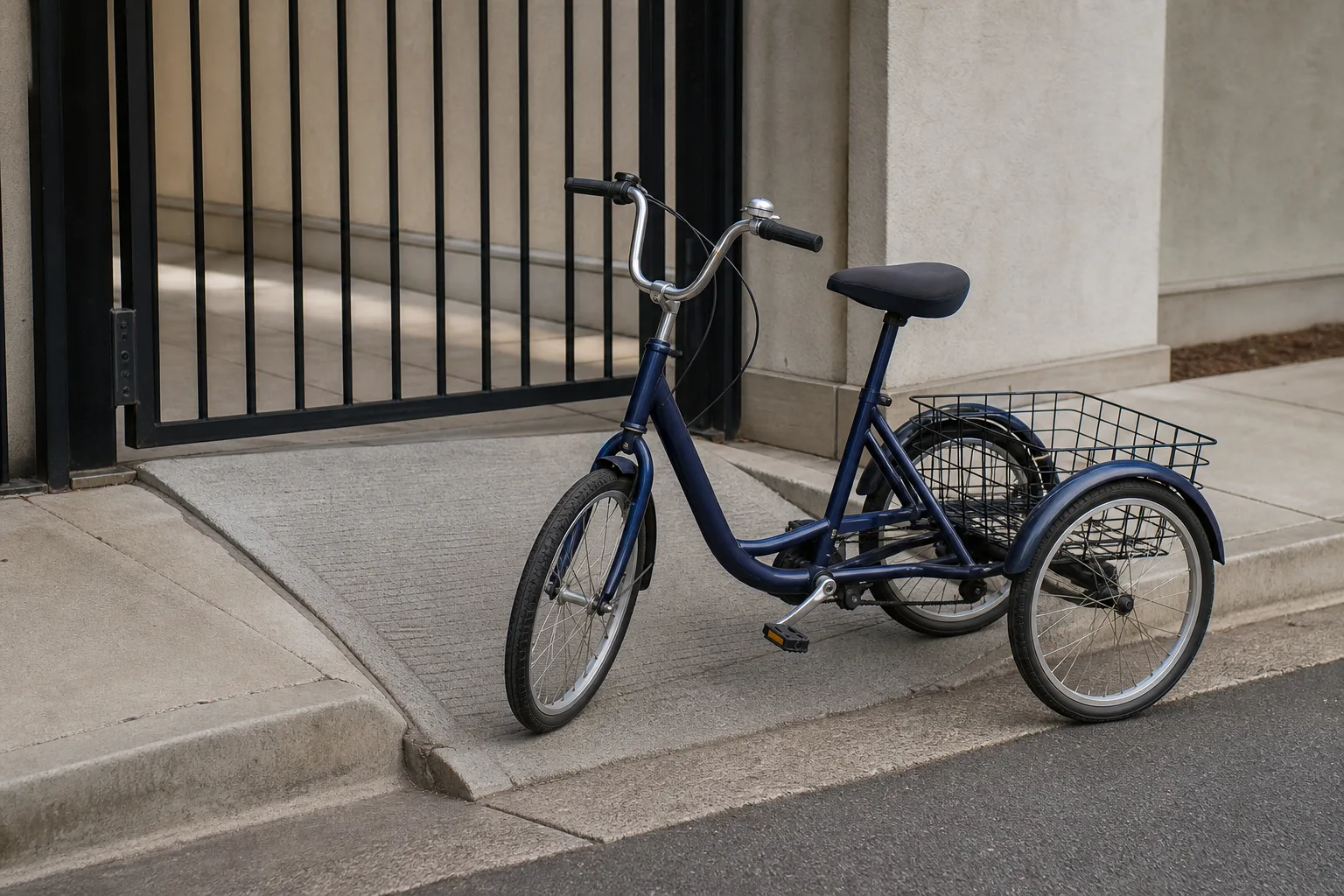
One rider's write-up after trying three-wheelers at two shops, a rehab centre loan pool and a used listing that turned out to be too wide for the gate. Most of it is about what happens after the purchase.
Two shops, a rehab center loan pool and one used listing produced the same lesson from four directions: the machine that feels best in a parking lot is not always the one that survives contact with a particular street, a particular gate and a particular trunk. Test rides happen on flat asphalt, in a straight line, with nobody waiting behind you. Ownership happens on a road that sheds water toward the gutter, at a corner where the curb ramp is blocked by a parked car, and in a side yard where the fence posts were set in 1994. The differences are measurable, and worth measuring before money changes hands.
A road is built higher in the middle so water runs off, and on a two-wheeler that slope disappears into the ordinary business of balancing, since the bike simply leans a degree or two and nobody notices. Three wheels cannot lean. The frame sits square to the pavement, the pavement tilts toward the gutter, and the trike wants to go where the water goes, which means a steady light pressure on the bars for the length of the block. The Federal Highway Administration is responsible for the design standards behind that crown, so it is not going away. What varies is how much steering effort it costs you.
The two shops differed sharply here. A trike with a wide track and a slack, unhurried steering geometry drifted gently and corrected with a fingertip; a narrower one with quicker steering wandered enough to be tiring within a mile. Both felt identical in the lot. The only useful test is to ride each one on a real crowned street, in the direction you actually travel, and notice whether the correction becomes background noise or becomes work. Ask the shop to let you take that ride. A shop that says yes is telling you something.
On two wheels a low curb is a shrug: unweight the front, roll up, carry on. A trike has three contact points that arrive at different moments, and the rear axle in particular does not forgive a four-inch step. That changes routes. The question becomes whether every corner between home and wherever you are going has a full curb ramp, whether the ramp is wide enough for your track width, and whether the lip at the bottom is flush or has settled into a small ridge. Ramps built to the Americans with Disabilities Act specification are generous. Older ones can be narrower than a delta trike's rear track, which is a thing to discover on foot with a tape measure rather than mid-turn.
The rehab center's loan pool was the honest teacher here, because a borrowed trike for a week produces the route knowledge that a twenty-minute demo cannot. One rider mapped a loop of four blocks and found two corners unusable, both because the ramp emptied into a drain grate. The fix was a slightly different loop, decided before the purchase rather than after it, and that loop then set the width the trike needed to be.
The used listing was a good machine at a fair price, and it was two inches too wide for the side gate, which is a discovery that arrives after the drive home. Measure the narrowest point on the path between the street and wherever the trike sleeps: the gate posts, the shed door, the turn at the bottom of a ramp, the elevator car and its door opening, which is usually narrower than the car itself. Then compare that to the published track width, and add an inch for pedals and mirrors. Folding trikes and models with a quick-release rear axle solve this, and several shops will demonstrate the fold while you time it.
A trike that lives in a shed and never enters a vehicle can be as heavy as you like. One that goes to a trail head on Saturdays needs either a fold you can perform twice without help, a hitch rack rated for the weight, or a car with a flat load floor and a sill low enough to slide onto rather than lift over. Weigh the actual machine, not the catalog figure for the base model, since batteries, baskets and a suspension seat add up quickly. The rehab pool's staff were blunt about this and correct.
Four measurements: the crown of your street, the ramps on your corners, the narrowest gap on the way to storage, and the height of your car's load sill. Take them first, and the choice narrows itself.