Balance at rest, solved
A three-wheeled cycle stands upright under a stopped rider with both feet still on the pedals. That removes the slow-speed wobble that makes stop signs and driveways unpleasant on two wheels.
Three wheels remove the balancing problem at rest and replace it with a cornering one, which is why the choice belongs to your streets and your body rather than a category.
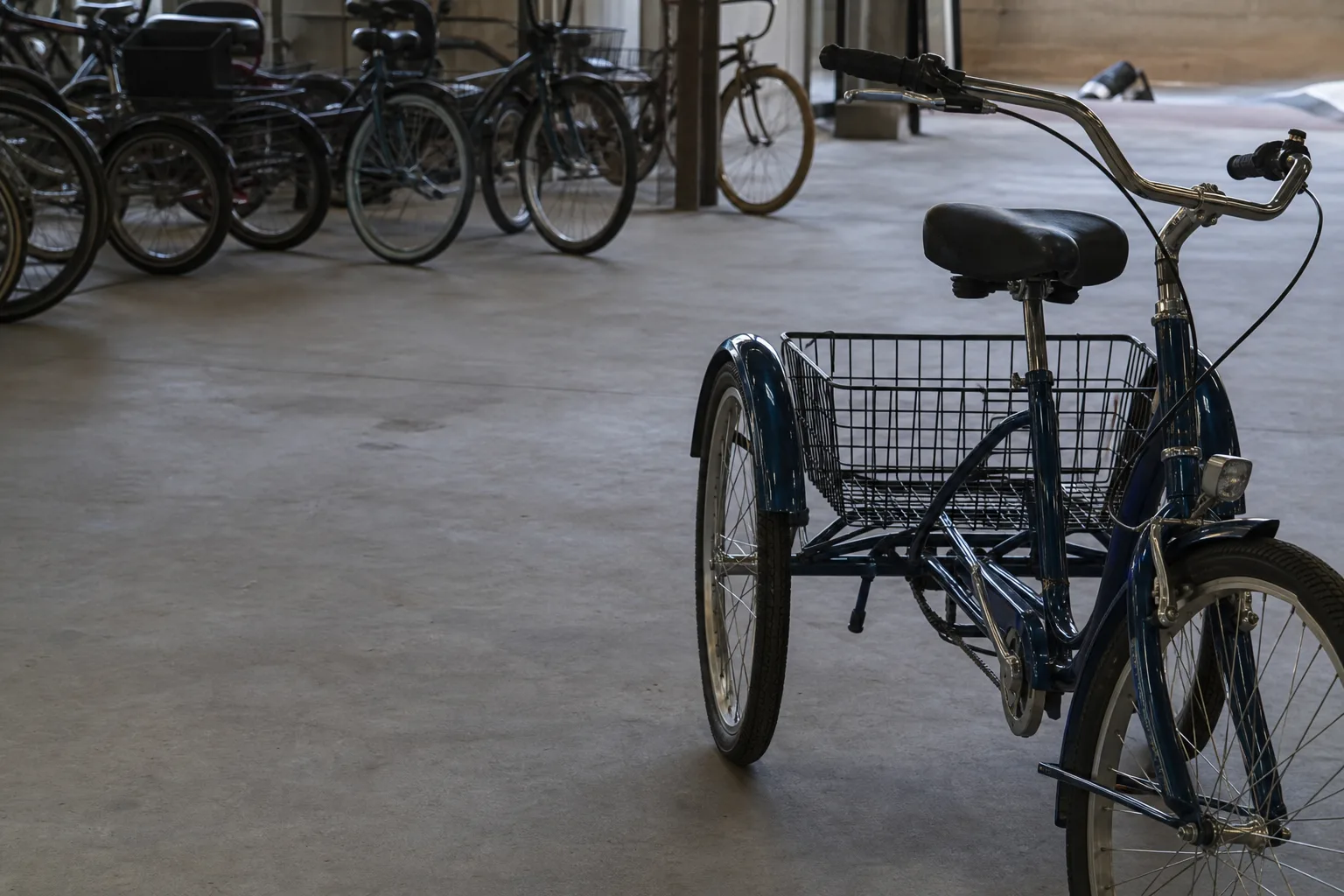
The first thing anyone notices on a three-wheeled cycle is that it stands still under them. Feet on the pedals, hands off the bars, the machine simply waits. For a rider who has been putting a foot down early at every stop sign, or walking the last twenty feet of a driveway because the slow-speed wobble had become unpleasant, that is the whole point of the exercise. What arrives with it, unannounced, is a different set of physics in every turn. The machine no longer leans, and the rider no longer leans it, and the cornering forces have to go somewhere else.
On two wheels, a turn is a lean, and the lean is automatic enough that most riders have never consciously performed one. Three wheels remove the option. The frame stays upright while the mass of the rider, sitting high above a narrow track, tries to continue in a straight line, and past a certain speed the inside wheel unweights and then leaves the pavement. It rarely happens on a flat parking lot at walking pace. It happens at the bottom of a hill, on a road that crowns toward the gutter, or on the tilted apron where a driveway meets the street, which is exactly where a new rider is least expecting it.
None of this makes the machine unsafe, and every experienced rider deals with it the same way: slow before the turn rather than during it, and shift weight toward the outside of the corner by leaning the upper body while the frame stays put. That is a learned habit, not an instinct, and it takes a few weeks of short rides on familiar streets to install. Seat height, seat position and how much of the rider's weight sits above the axle all move the speed at which the wheel lifts, which is why two machines with identical specifications on paper can feel quite different underneath the same person.
A cycle is not chosen against a category. It is chosen against a route, and the route is usually short, repeated, and full of specific obstacles: a driveway that slopes sideways, a gate opening of a fixed width, a stretch of road with a pronounced crown, a stop sign at the foot of a grade. Ride the route in a car and count them. A machine that handles a flat rail trail beautifully can be tiresome on a half mile of cambered residential street, where the low side of the road tries to steer the front wheel downhill all the way home.
The body sets the other half of the answer. Hip range, shoulder reach, grip strength and the height of a step-through opening decide whether mounting is a routine or a production, and a rider who cannot swing a leg over a top tube will not use a machine that requires it, however stable it is once seated. An electric tricycle answers a hill that would otherwise end the outing, though it also adds weight that has to be pushed backward into a shed and steadied on a slope. The Consumer Product Safety Commission is responsible for the federal requirements that apply to bicycles sold in the United States, including braking and reflector rules, which is a useful baseline but says nothing about whether a given frame fits a given hip.
The purchase price is the visible number and usually not the largest one. Space is the first hidden cost, because a three-wheeled machine is roughly twice as wide as what it replaces, does not lean against a wall, and cannot be hung from a hook. Garages get rearranged. Gates get widened, or a new latch gets fitted, or the machine lives under a cover on the side of the house. Transport is the second cost, since most trunk racks are designed around two wheels and a narrow frame, and moving one any distance tends to mean a hitch platform, a van, or simply accepting that the machine never leaves the neighborhood.
Then there is the cost paid in time. Expect several weeks of deliberate practice before the cornering habit is automatic, and expect the first month to include at least one moment where a wheel lifts on a driveway apron and the rider learns something quickly. Service is a smaller but real line item: rear axles, differentials and internally geared hubs are common on these machines and not every shop works on them, so it is worth asking, before purchase, who in town will. A rehab center loan pool, if one operates nearby, lets a rider spend a week discovering all of this on someone else's machine.
A parking lot test ride answers almost nothing, because parking lots are flat, wide and empty. The useful test is a slow figure eight, a stop and restart on a slope, a turn taken across a camber, and a mount and dismount performed five times in a row while slightly tired. Measure the track width with a tape and compare it to the narrowest gate on the route, allowing for knuckles. Push the machine backward for twenty feet, since that is how it will be parked. What survives that list is the machine that gets ridden.
Stability on three wheels is real, and it is specific: it is the removal of one problem, balance at rest, and the arrival of a smaller, more learnable one that responds to speed and body position. Riders who treat the first month as training rather than ownership tend to come out the far side riding more than they did before.
| Item | What it means |
|---|---|
| Counter-leaning as a skill | The fix is to lean the upper body toward the outside of the corner while the frame stays vertical. It is a learned habit rather than an instinct, and it takes weeks of short rides to become automatic. |
| Track width versus gate width | Measure the rear track with a tape and compare it against the narrowest gate, door or path on the regular route. Allow extra for knuckles on the handlebars. |
| Storage is a real expense | These machines are roughly twice as wide as a two-wheeler, will not lean against a wall, and cannot be hung from a ceiling hook. Garage space, a wider gate or an outdoor cover is part of the purchase. |